Scientific Research, Books, Articles, Columns, Lectures and Photographs
Hawai'i's Mauna Loa Observatory
This page is devoted to Hawai'i's historic Mauna Loa Observatory, which began monitoring the atmosphere in 1956. From May 2006 to October 2009, I worked nearly full time writing Hawai'i’s Mauna Loa Observatory: Fifty Years of Monitoring the Atmosphere. This 265,000-word book was written under contract with the National Oceanic and Atmospheric Administration (NOAA) and was extensively revised and expanded following three rounds of reviews by a 25-member panel of scientists and former Mauna Loa Observatory staff. The book was published in 2012 by the University of Hawai'i Press.
The Atmospheric Science Librarians International (ASLI) selected Hawai'i's Mauna Loa Observatory “for the ASLI’s Choice 2012-History award for its engaging perspective on the scientists, discoveries, and ground-breaking atmospheric measurements done at Mauna Loa Observatory. ASLI's Choice is an award for the best book of 2012 in the fields of meteorology / climatology / atmospheric sciences.”
Mauna Loa Observatory
The Mauna Loa Observatory (MLO) was dedicated on 28 June 1956 by some 80 people who made the difficult drive from Hilo. The observatory is at an elevation of 3,400 meters (11,200 feet) on the north slope of the giant Mauna Loa volcano, earth's largest single mountain mass.
I have been calibrating various atmospheric instruments at MLO at least once each year since 1992. Some of this research will eventually be described on this page, which will be expanded to include more about the history of this most famous of NOAA's observatories.
Mauna Loa Observatory Lidar
Dr. John Barnes has been probing the stratosphere over the Mauna Loa Observatory for more than 13 years. The brilliant green beam of his laser is scattered by aerosols back to a telescope that focuses the light onto a sensitive photomultiplier tube.
Dr. Barnes has monitored aerosols from volcanoes, dust and air pollution from China and water vapor. Some of his measurements are timed to match overpasses by NASA's Aura satellite.
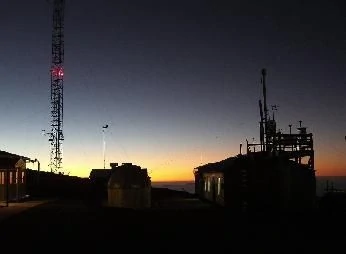
Sunset at the Mauna Loa Observatory. Copyright by Forrest M. Mims III.

The Mauna Loa Observatory lidar probes the stratosphere on 5 December 2006. Copyright by Forrest M. Mims III.

The air sampling tower at Mauna Loa Observatory is 120 feet high. Copyright by Forrest M. Mims III.

Mauna Loa Observatory as seen from the meteorological tower. Copyright by Forrest M. Mims III.

The Mauna Loa Observatory with Mauna Kea in the background. Copyright by Forrest M. Mims III.

The Mauna Loa Observatory with Mauna Kea in the background. Copyright by Forrest M. Mims III.

NDSC (Network for Detection of Stratospheric Change) building (1997) at the Mauna Loa Observatory. The ozone layer, UV-B, atmospheric transmission and column water vapor are monitored from the rooftop deck at right. Copyright by Forrest M. Mims III.

Dr. John Barnes conducts a lidar session at the Mauna Loa Observatory. Copyright by Forrest M. Mims III.

Clouds rise up toward the Mauna Loa Observatory. Copyright by Forrest M. Mims III.